There was an almighty punch up in Brisbane city centre in the middle of the second world war as niggling irritations sparked by the presence of large numbers of American soldiers erupted into a riot. It was hushed up at the time for fear of damaging already fragile morale.
The Diggers – as Australian troops were commonly known – were frustrated by the lack of facilities in Brisbane. As one later recalled: ‘Several large canteens run by various organisations were kept busy providing meals, tea and sandwiches and so on but not of course, the amber fluid’.
Hotels had only two one-hour drinking sessions a day; these would be hailed by a triumphant cry of ‘The beer’s on!’ which would see a rush on the pub. Brawls between the two sets of troops were frequent, with up to 20 a night reported. The bad feeling reached fever pitch on 26th November 1942.
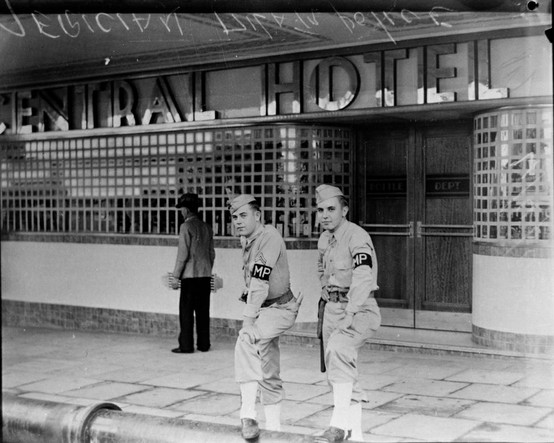
The tension had to break and it did, spectacularly, into what became known as The Battle of Brisbane. There are a few versions about the details of how it started. Because the authorities immediately censored any news of the brawl for fear of souring relations between the two countries and potentially spreading the animosity further afield, modern day reconstructions of the events of that November night have to be based on memories of those involved, but there is general agreement on the main events.
It was almost seven o’clock in the evening. The pubs had chucked out ten minutes earlier. The streets were full of servicemen, many of whom had been drinking. An American soldier, Private James Stein, had been drinking XXXX beer in the Australian Army Canteen in Adelaide Street with some Aussie mates. An American military policeman, Private Tony O’Sullivan, stopped him at the Creek Street intersection and asked to see his pass. Stein, perhaps with alcohol affecting his coordination, was fumbling in his pockets to try and find it (he did have one, it was later found) when O’Sullivan became agitated and started to abuse him. His three unidentified Digger mates took exception to this and told O’Sullivan to back off. It quickly escalated.
Eyewitnesses say that more Australian soldiers and even a few civilians joined in to help their mates, one describing it as ‘an opportunity to settle a few old scores’. More American military policemen, who were generally considered arrogant and aggressive, and were despised by all, came to O’Sullivan’s assistance but they were outnumbered and retreated to the American PX canteen (Post Exchange and Canteen – described as ‘large and lavish’ by one Digger) on the corner, half dragging, half carrying O’Sullivan with them.
By this time there was a sizeable crowd outside the PX canteen throwing bottles, rocks and whatever else they could lay their hands on, including a parking sign, through the windows. Fighting, mostly now between any American and Australian troops, spread to other parts of the City Centre in a frenzy of pent up frustration and score settling.
Women were escorted from the City by soldiers with bayonets fixed. By eight o’clock – an hour after the initial incident – at least 2,000 and maybe as many as 5,000 people were involved in the brawling. Some Australian military policemen reportedly removed their MP armbands and joined in the fighting. Suspiciously too, the Fire Brigade arrived but did not immediately use its water hoses, for which it was later criticised by the American authorities, although one digger said hoses were in fact used. Perhaps they were used only after the old scores were well on their way to being settled.
Eventually some American military policemen at the PX canteen were issued with 12-gauge pump-action shotguns and they elbowed their way to the front line of those trying to protect the place. Some elements in the crowd saw the first MP with a shotgun, Norbert Grant, and tried to wrestle it off him. It is said by an American observer that Grant jabbed a digger with the gun, while another grabbed at it and a third held him around the neck. The gun went off, killing Gunner Edward Webster from northern Queensland. Another two shots were fired. Altogether five other soldiers and two civilians were wounded.
After a momentary, no doubt stunned, silence, Grant pushed his way back towards the PX canteen, breaking the butt of his shotgun over an Australian head on the way. One American had his skull fractured.
An Australian observer reckons rather that the military policemen opened fire when they failed to gain control. Given that only three shots were fired, the American version seems more likely. Had there been an order to open fire, more people would have surely been killed and wounded.
One American observer on the sixth floor of the AMP building said he saw a crowd of about 500 Australian servicemen at the intersection of Adelaide and Queen Streets. They had formed into three circles and were passing American solders over their heads into the centre of the circles where they were punched and kicked.
He also saw some Australian soldiers with batons encounter about 20 American military policemen. The Americans lined the tram tracks and drew their handguns. An Australian officer persuaded the American commander to take his men away from the area in a truck.
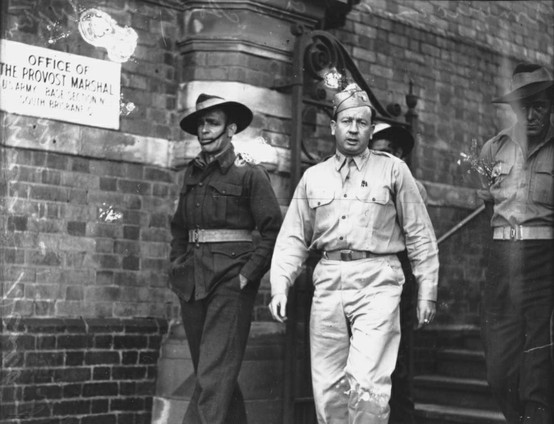
By ten o’clock things had quietened down but by then the PX canteen was destroyed. There was some sporadic fighting the next night and several MP patrols were attacked. The authorities decided to ensure it did not happen again. The units involved were transferred out of Brisbane; the Australian and American canteens were moved. The Censor ordered that there was to be no broadcasting or cabling of the events in Brisbane. The next day’s Courier Mail ran a heavily censored article about a disturbance. Nevertheless wild rumours abounded, including one that had 15 Australians mowed down by machine gun fire.
Grant, the gun toting American military policeman, was court marshalled for manslaughter in the following February but acquitted on grounds of self-defence. Five Australians were convicted of assault, one of them jailed for six months.


Leave a Reply