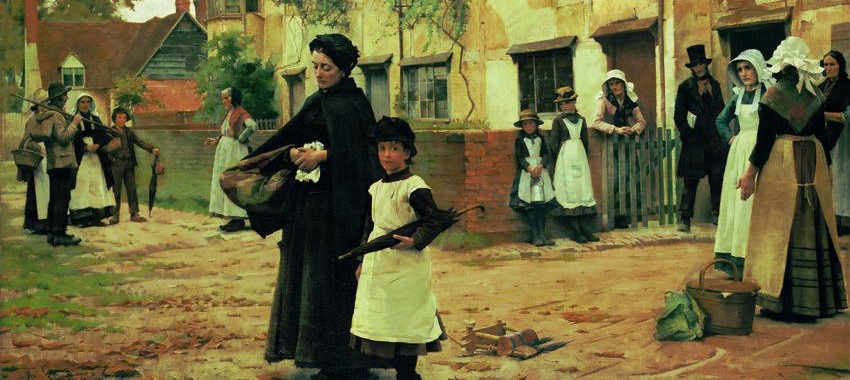
British artist Blandford Fletcher’s 1887 painting Evicted wasn’t trendy when the Queensland Art Gallery (QAG) purchased it for 300 guineas in 1895.
In the 1890s, the western world’s painters were in full retreat from naturalism or realism – an approach to art that pays attention to very accurate and precise details, and purports to portray things as they are. By contrast, Edvard Munch painted The Scream in 1893, for example. Artists in Paris had already moved beyond Impressionism, typified by the bold colours and brush strokes of Van Gogh. Paul Gaugin was painting figuratively in Tahiti and was experimenting with the bold use of colour.
Rather than an experiment in avant-garde painting the ultra realistic Evicted makes a strong social statement about the impacts of the Industrial Revolution and a declining rural economy on people not well-placed to deal with them..
And perhaps those early QAG administrators have been vindicated because for the 120 years since, it has been Brisbane’s favourite painting on show at the Gallery. If it is off the wall too long for a clean up, questions are not long in coming about its whereabouts.
I am much attracted to it too.
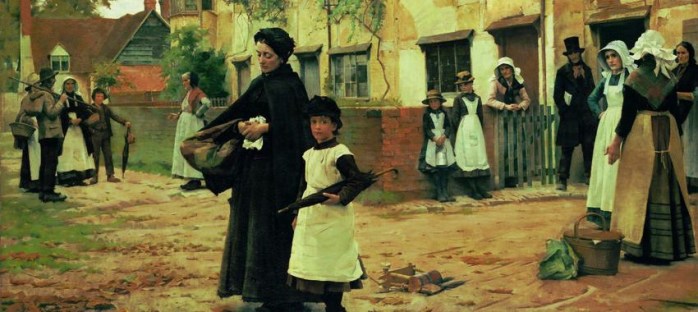
At first glance it might be a chocolate box painting of a quaint English village scene of the late Victorian era. Yet it is much more than that. The centrepiece is the arresting gaze of the child at her mother’s side: innocent, uncertain, apprehensive. The mother, probably a widow, is forlorn and preoccupied, perhaps with all her worldly possessions in the bag under her right arm. Yet they retain their dignity: they have taken care with their clothes, which are evidently clean, highlighted by the girls’ white chemise, but perhaps past their best, with a suggestion that the hem on the Mother’s dress has started to fray. Off to the right the bailiff stands, legs confidently astride, hands in pockets with the eviction notice under his arm: he has clearly heard all the excuses. The village women on the right are sympathetic yet not solicitous; they are resigned to a hard life on the edge. The group to the left is indifferent; hardly paying attention: evictions are commonplace. It is an persuasive depiction of the plight of so many at the time.
The almost photographic representation in the work, the near life-size figures and the wide view of the village street convey a sense of reality. The tones of the overcast autumn day heighten the sense of loss and sadness. The painting is inevitably part of a ‘school’, Victorian social realism, whose painters sought to attract attention to the plight of the social underclasses.
The girl’s wooden toy horse is dragged behind her. It is missing a wheel and is on its side. It is a poignant comment on this single parent family’s straightened circumstances, though to my modern eye it is the one aspect of the painting that I think is over the top.
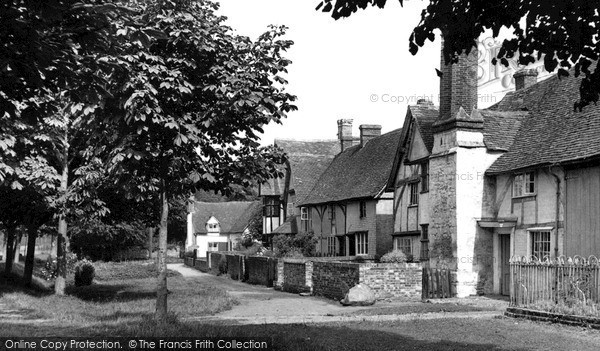
QAG report that the painting is set in the Berkshire village of Steventon in England, the traditional lime-washed houses, dating from the sixteenth century, still stand today. Perhaps as seen on Google Maps here, and certainly in the 1955 image below from the Francis Frith Collection.
Through a child’s eyes
Evicted inspired the late Betty Churcher as a child in Brisbane. (She went on to become the Director of the National Gallery of Australia). She said she loved its gentle grey tonality. ‘But what really got me in that picture were the autumn leaves on the ground. They were just crisp and you felt you could just crunch them up in your hand.
‘And it was [about] that tactility and reality that I thought, `If only I could do that.’ I used to think up all sorts of ploys to get my parents to go back to the gallery just so I could see Evicted. I just used to go to Evicted like a bee to honey.’
In the last years of her life, with her eyesight failing, she returned to QAG in her wheelchair to sketch for her final project, a beautifully illustrated book entitled Notebooks. She sat in front of Evicted, mindful of her brother Ian’s insistence that she include this picture because of her constant badgering as a child.
‘And, lo and behold, my eye level in the wheelchair was the same as my eye level as a seven-year-old.’ Those autumn leaves in the foreground, she said, as if seeing them fresh, appear so real you could scrunch them into dust. ‘I fell in love again’, she wrote, ‘with the wonder that paint could transform a stretch of bare canvas into a whole new world for a little girl.’
What intrigues me about Churcher’s reminisces is that as a seven year old she felt no compelling affinity with the girl in the painting. Everything is in the eye of the beholder, evidently.


Leave a Reply