You do not see many Aborigines in Brisbane. They are around of course. Official figures show there are over 53,000 in southeast Queensland, about 1.2% of the City’s total population.
There was a whopping 22% increase in the number of indigenous people in Greater Brisbane between 2006 and 2011, over twice the rate of increase in the whole population. The Australian Bureau of Statistics says some of this was the result of natural increase and migration while some of the increase is the result of people changing their racial classification to identify as indigenous. This has been a fairly consistent theme over the past two decades.
It is not always easy to spot an Aborigine, at least to the unfamiliar eye. I have often been surprised to discover someone is Aboriginal, when they look to be of European descent. Why do people see themselves as Aboriginal when they have a fair chunk of white blood?
Renowned Brisbane-based Aboriginal artist Judy Watson, who is relatively light skinned, has said: ‘My grandmother has always been in my life. I do not deny my white parentage, but I am very close to my grandmother and very connected with her story through the matrilineal side of my family that’s the Aboriginal side. I think there’s a stronger pull when you know your ancestors have been in a place for 40,000 years’.
And dig a little deeper into history and you will find that part-Aborigines, or ‘half-castes’ as they used to be disparagingly called, were significantly discriminated against until well after the Second World War. Many ‘half caste’ children were taken away from their parents by government agencies to be raised as white by foster parents. On the face of it this might seem to be a positive life event in that it improved the career and material prospects of these children who became known as the Stolen Generation and no doubt this was the motivation behind the government’s policy of assimilation. However, it was a deeply traumatic experience for most of them that stayed with them for life, no matter how nurturing the foster parents were. I do not know personally anyone from the Stolen Generation but I am familiar with how a similar event had an impact on my late father-in-law. He was born of dirt-poor parents in Yorkshire, England after the First World War. A rich aunt from the colonies offered to take him ‘home’ and bring him up in relative wealth. He was always grateful for this act of generosity but he was adamant that he would rather have stayed with his family and battled it out.
Research from a variety of sources about the Stolen Generation and the English children sent to Australia in the 1950s, for example, consistently reveals that when many of these children reach adulthood they have a sense of worthlessness that comes from real or imagined rejection by natural parents, and a loss of identity even when they have been raised by loving foster parents.
You can usually see some Aboriginal people around Musgrave Park on Brisbane’s south side. I am not advocating tourist trips there, just recording a presence. It is sacred ground. But the greatest relative concentration is on North Stradbroke Island twenty kilometres offshore in Moreton Bay, where they represent about a fifth of the population, some of whom live in a semi-traditional way. They are probably the only Aboriginal people in the Brisbane region who have lived continuously in one spot since before European settlers arrived in 1829.
This is almost certainly because white men did not want this land and because the island has never been connected to the mainland by a bridge or causeway. But while white men might not have, unusually, wanted to take anything from them, around 1840 the locals were harried for a while by Roman Catholic missionaries who sought to convert them and make them ‘behave much better’. The missionaries felt they should wear European style clothes, for instance, because their state of nakedness was scandalous to prudish Victorian values. They also wanted them to get married in church, wedding rings, vows and all. The arrogance of missionaries knows no bounds. Fortunately, the Stradbroke Island Aborigines, traditionally known as the people of Quandamooka – in three clans, the Nughi, the Nunukal and the Grenpul – fought off the attack on their culture and reverted to their natural and naked state.
Historical and archaeological evidence shows that Aborigines were living in the wider Moreton Bay region when white settlers first arrived, the centre of which, around the modern day city Botanical Gardens, they called Meanjin, the place shaped like a spike, and which is now called Brisbane.
As for the River, its name was Waar-rar and ‘every reach and bend’ was separately identified in local Aboriginal dialects, according to an early white resident Tom Petrie. The Reverend J. D. Lang, following a visit to Brisbane in 1845, confirmed the extensive territorial associations. ‘Every rock, river, creek, mountain, hill, or plain, has its native name.’
The estimated 5,000 people in the region were split among two predominant groups, the Turrbal who lived north of the Brisbane River (called the Duke of York’s clan by the whites settlers) and the Jagerra, who lived on the south and out towards the Brisbane Valley. These larger language groups were, according to J.G. Steele, split into about ten tribes and sub-tribes living along the Brisbane River from the source to the mouth, the area etched with walking tracks and punctuated by common crossings.
Archibald Meston identified seven separate dialects around Moreton Bay, all differing widely, some with more extensive vocabularies. These were frequently changing, characterised by ‘amazing flexibility’ and ‘astonishing modification of verbs’ by suffixes and affixes. The average person, he said, could speak but a fraction of his own language and a little of the two adjoining dialects. A wife from a separate area learned and spoke the language of her husband, and children were frequently bi-lingual. He described Aboriginal languages as ‘soft and euphonious’, and English as ‘discordant by comparison.’
This made it one of the most densely populated regions in pre-white settlement Aboriginal Australia. It is thought that the low-lying swamplands of South Brisbane were one of the main and regular camping spots of the Turrbal. The north facing riverbank had a sandy beach called Maroochy (or swimming, suggesting what it was used for) and it was a favoured place for river crossings.
There were many campsites around Brisbane, including those at Woolloongabba, Toowong, Bowen Hills, Newstead, Nundah, and Nudgee. Although Aborigines pretty much lived within their own clans and in their own areas, there were important occasions when there were gatherings of clans. Toowong (an Aboriginal word which means koel cuckoo) and West End (originally Kurilpa – the place of rats and mice) were regular camp sites for gatherings and visiting clans. It is said that early white settlers in Toowong occasionally heard the sounds of corroborees (meetings, usually religious) deep into the night well into the middle of the 19th century. Representatives of a number of groups gathered for tournaments and ceremonies at Pullen Pullen. There were other ceremonial sites, one by the banks of Moggill Creek (moggill means large water lizard) and another on the slopes of Mt. Elphinstone, judging by stone tools that have been found in various locations.
Researcher Ros Kidd has reported that corroborees were a major occasion for inter-tribal gatherings and it was common for between two and three hundred performers to take part in these dramatisations of key incidents. Days were spent gathering pigments, including pipe clay and the soft red rock that was ground and mixed with the ‘coochie’ or fat from possums and porcupines and the wax of the ‘cubba’ or new honey. According to William Clark, an early white resident who moved into South Brisbane in 1849, the effect was sensational: ‘… when fully adorned was so strangely metamorphosed that his friends did not know him. He had white stripes down the legs and the body was fantastically marked with red, the toning of the red round his eyes with the dark grounding of his skin gave him a weird appearance’.
After many days of rehearsals, large fires were lit on the designated evening, lighting up the bush for a considerable distance around. Rhythmic chanting was accompanied by the women seated in the rear beating sticks upon a drum ‘of tightly folded skins placed on their knees’ or slapping their thighs. Men danced in the arena lit by the fire and as the chanting increased in tempo and volume, white spectators were impressed ‘with a feeling of awe and they began to gain an idea it was the recounting of some real adventure of native life.’
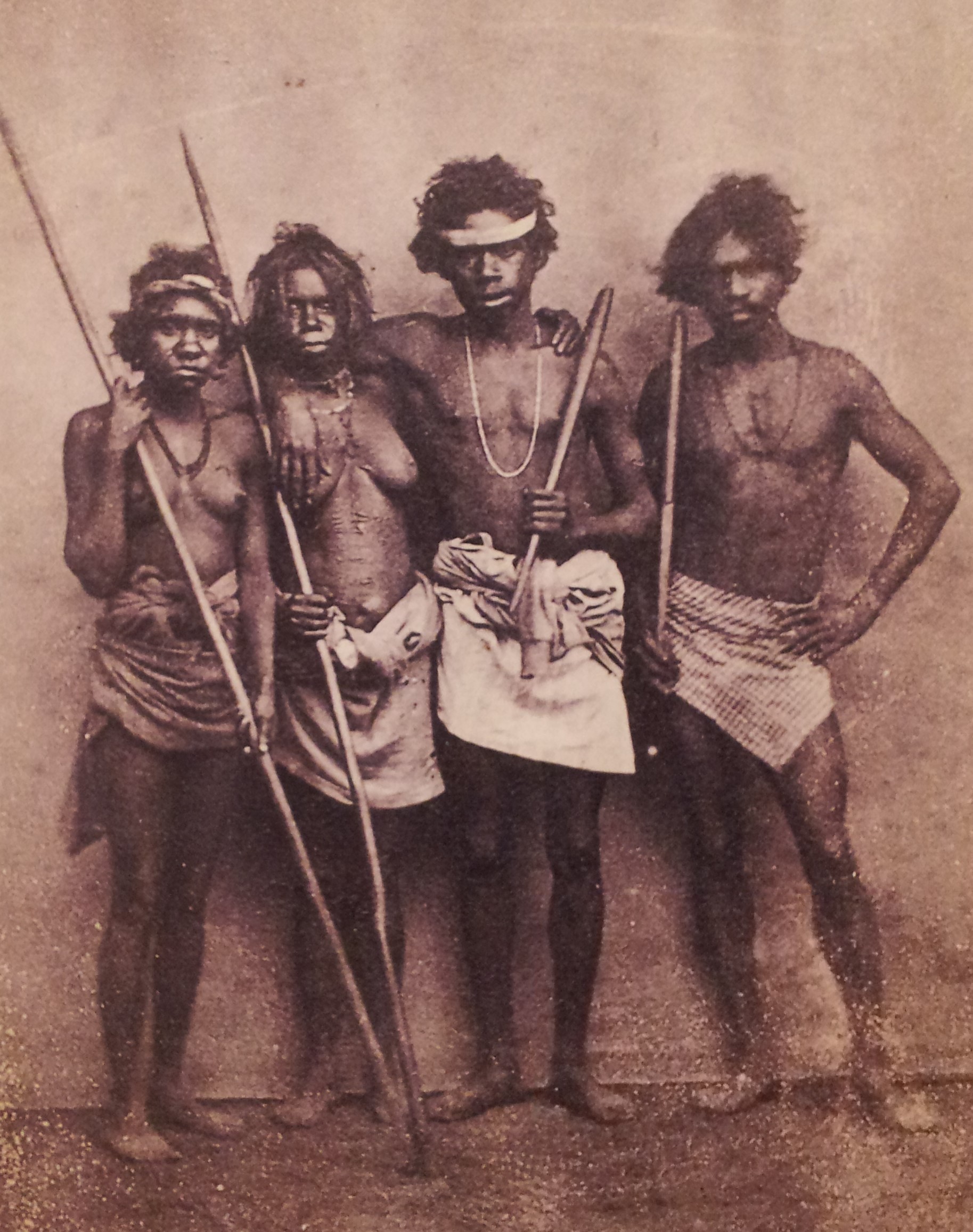
Youngsters posing in a Brisbane studio in the 1850s
One of the most important ceremonies of Aboriginal culture took place on sacred bora grounds (or bora rings, because they were circular). This was where young men were initiated into the tribal laws and customs that formed the basis of their way of life. It was a time when they were given the information they would need as adults. The bush and country in which they lived was harsh and the laws that were imposed upon the men and women of the clan had developed over many centuries to ensure their survival.
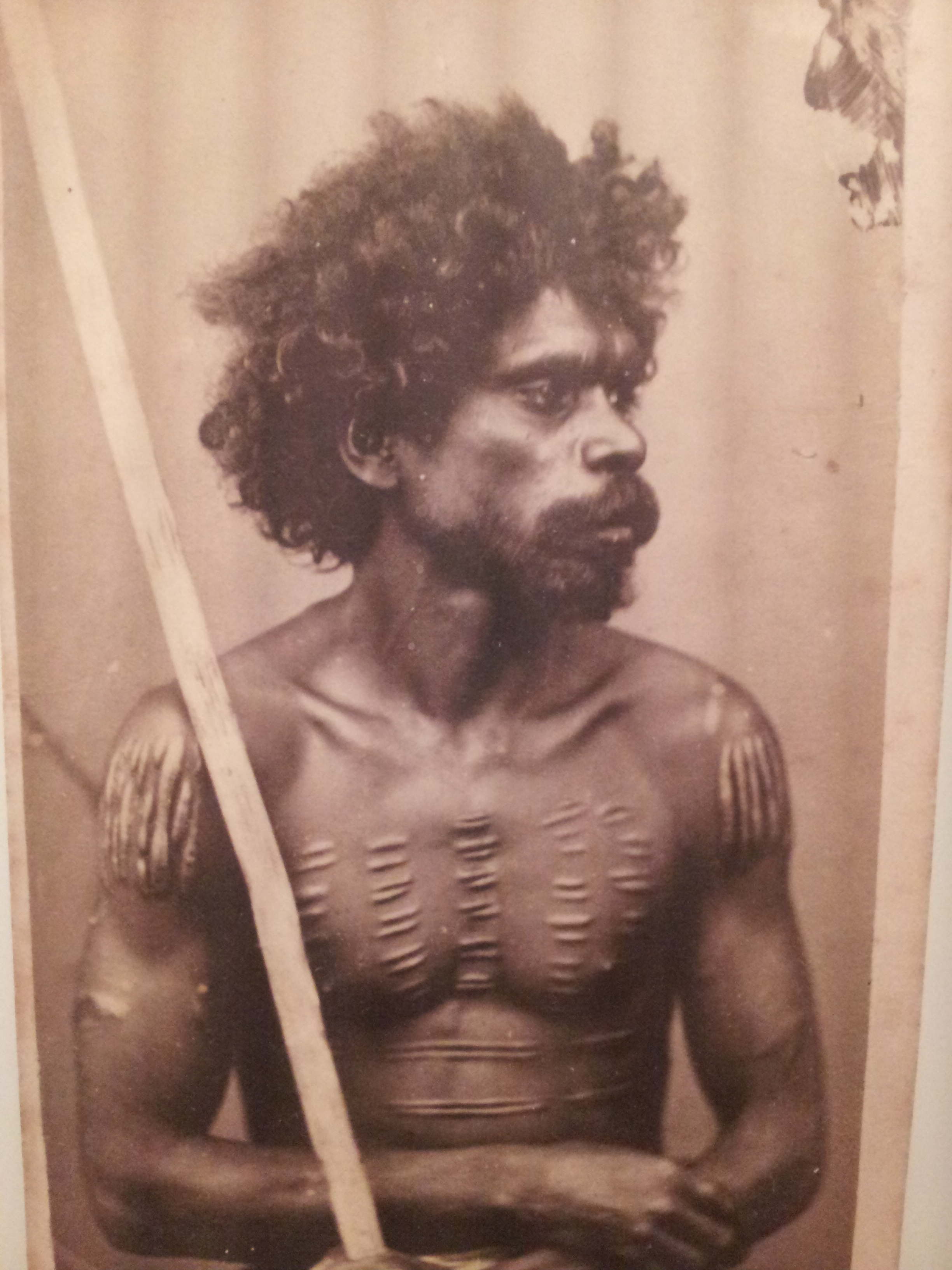
Both girls and boys had to pass through an initiation ceremony, but it has been said that by far the most exacting and important was the Bora ceremony for the young men of the clan. A boy’s childhood was carefree but once he passed through the bora ring, he had to accept all the responsibilities of manhood. The initiation ceremonies varied from clan to clan and few details are known, however we do know that the knocking out of teeth, circumcision and scarring of parts of the body were some of the tests that had to be passed by young men.
William Clark and some friends tried to watch one of these ceremonies but Aboriginal elders stood guard around the base of the hill and, although they knew Clark and his friends, they whirled ‘bull roars’ to warn off the uninitiated. These ‘bulls’ were made of hard dry kangaroo skin tied to ‘bugaroo’ or native string, making a deafening roar when whirled round and round.
Dr Kidd, who has trawled through a mound of unpublished records and reminiscences, reported that the young initiates were specially dressed and painted, and wore beads and amulets. At a separate camp near the rings they would sit in a circle while the ‘turwans’ or elders stood behind them, instructed them quietly in tribal and hunting secrets. As young men many foods were now denied them, including new honey and fish roes. On occasion the boys would be sent into the swamps to catch frogs to eat; they were also allowed to feed on the geebung, a native fruit with a delicious soft yellow pulp.
On the other hand, we do not know anything at all about female initiation. It has a remained a secret tightly held among Aboriginal women, who do not even tell their menfolk what is involved. In modern day Australia these female rites of passage are described as ‘secret women’s business’.
According to J.G. Steele’s Aboriginal Pathways there are or were about a dozen bora ring sites in Brisbane and its suburbs, including ones in inner city West End, Moggill, Nundah, Goodna and Samford, which adds weight to reports that Brisbane was a densely populated area.
Everyday life for the Aboriginal clans consisted of hunting and gathering food, with time for games and other social and spiritual activities. Both the Brisbane clans roamed over a large area that included forest, scrub and the swamps, lagoons and pockets of rainforest of the coastal lowlands. The River in particular was a rich source of food.
Of course, the settlers have written the early history of encounters between settlers and Aborigines. Like most history, the winners wrote it. Aborigines passed their history down by word of mouth from generation to generation. One assumes that the more aware of the first white settlers to arrive in Brisbane had a similar impression to that of Captain James Cook when he first saw Aborigines in Sydney Harbour half a century before. He wrote that ‘they may appear to some to be the most wretched people on earth, but in reality they were far happier than we Europeans. They live in tranquillity which is not disturbed by the inequality of condition’.
One of the first settler comments recorded locally for posterity was made by Surveyor General John Oxley who in 1824 was exploring the Brisbane River under orders from New South Wales Governor Thomas Brisbane. He saw a large group of Aborigines near the river at what was to become Toowong and noted they were ‘about the strongest and best-made muscular men I have seen in any country’. There are also stories passed down by settlers that the indigenous people of Moggill were well-built, keen of eye, fleet of foot and quick to learn. The Moreton Bay district was always known as a healthy place. This was a time when the general population of Britain were smaller in stature, often scrawnier for want of being properly fed and generally much less healthy than they are now, which would have made the contrast with the Natives all the more notable.
In the very early days of white exploration of the area, there were friendly relations between the old inhabitants and the newcomers. In March 1823 Thomas Pamphlett, a ticket-of-leave man – the term applied to a convict who had been granted parole – along with three others, set sail from Sydney in a nine-metre open boat bound for Lake Illawarra to the south to trade for cedar with pork and rum they had on board. They got caught up in a violent storm that carried them out of sight of land. It lasted for five days by which time they had lost all sense of direction and distance travelled. When they beached on Moreton Island, having lost one of their party overboard, they thought they were still south of Sydney. They spent eight months in the Brisbane area living on fish and fern roots mostly provided by friendly local natives before returning to Sydney. Pamphlett later told John Uniacke, a writer chronicling stories by castaways, that Aborigines’ ‘behaviour to me and my companions had been so invariably kind and generous, that, notwithstanding the delight I felt at the idea of once more returning to my home, I did not leave them without sincere regret.’
He told of one occasion when they ‘went on towards the huts where we had lived with the natives. About half a mile before we reached them we saw the natives fishing: they had been quite successful; and on seeing us they immediately put a quantity of whitings on the fire. Nor would they allow us to proceed till we had filled ourselves with them’.
Edmund Lockyer, exploring up the Brisbane River in 1825 wrote in his diary about seeing some Aborigines on the river bank: ‘they were perfectly naked, stout, clean-skinned, well made people and showed no symptom whatever of hostility. From the short intercourse I had with them. I do not think they had ever seen a European before…’
Neville Bonner, the first Aboriginal senator in Federal Parliament, who died in 1999, was born into the Jagera clan in 1922 around the Queensland border with New South Wales. He confirmed in an interview that some of the new settlers lived in harmony with the earlier people. In return for tea, sugar, flour and beef, the Aboriginal people brought gifts of honey or helped clear fields of stubble.
But this good fellowship did not last nor did it extend to all. There was little sense of mutual understanding or tranquillity after those tentative meetings in the early days in Brisbane because, as Bonner said, the Jagera people did not give up their lands without a fight, and that is what the settlers were there for.
‘Sometimes white people were killed and some Aborigines died. In 1828 a soldier took a precious relic from a bark hut near the present site of Moggill Ferry and gave it as a scientific specimen to Allan Cunningham, the botanist and explorer. It seems that a boatload of soldiers and convicts was ambushed by the Jagera warriors at the Seventeen Mile Rocks in retaliation for the theft of a sacred possession. The biggest battle between the Jagera and non-indigenous people was outside of Gatton. The Jagera leader was Multugera, whose descendants still live in the area.’
Nothing could compensate them for the loss of their land, he said. By the 1930s, most of the Jagera had gone. Sometimes, he said, their dingos can still be heard, crying in the night from surrounding hills.
As the changes brought about by white settlement impacted on all aspects of traditional Aboriginal life some indigenous people began performing jobs around the town for white paymasters. These ranged from domestic work to drawing water and running errands. In 1857 settlers started to worry about the growing native presence in the township of Brisbane and banned Aborigines from entering the town boundary after half past four in the afternoon.
In 1852, the settlement’s boundaries were marked by iron-bark posts, effectively marking a square mile of exclusion. These posts marked the town from the suburbs. Boundary Street in West End became one of the city’s limits with Boundary Street in Spring Hill marking the other.
In 1858 two Aborigines, Dalinkuaand and Dalpie from around Breakfast Creek, wrote letters to the Moreton Bay Courier protesting about the treatment their people received at the hands of the white settlers, but to no avail. Nothing changed.
In 1897 the state government introduced an authoritarian piece of legislation called the Aboriginal Protection and Restriction of the Sale of Opium Act. Queensland was divided into districts and missions, and reserves were set up within the districts. Aborigines were removed to these areas and although some were able to stay and work for white bosses, Brisbane lost most of its indigenous population.
The curfew was still in effect for those that remained in the area by the time Bonner was born in 1922. He told an interviewer that he ‘was born on Ukerebagh Island, in the mouth of the Tweed River. Because there was nowhere else for my mother to go, in those days, Aboriginal people had to be out of the towns before sunset. And they couldn’t get back into town again until sunrise the next day, my Mother was not allowed to go to hospital to give birth to me, she gave birth to me in a little gunya under the palm tree, that still lives down there, on a government issued blanket. Those are the kind of things that we had to cope with when I was born and when I was a small child, right up into my teenage years and into my manhood.’
In the 1930s further state legislation tightened the government’s grip by consolidating ‘protection’ and control, including banning sex between white men and indigenous women.
A sympathetic Judith Wright recalls seeing Aborigines in 1943 in wartime Brisbane. They were a ‘visible presence, a background of dark sorrowful faces. As I travelled between the north and south sides of the River, the tram carried me through suburbs where they seemed to predominate…’ She remained a lifelong critic of how White Australia treated the indigenous population.
There is a persistent theme of injustice and inhumanity about the treatment of Aborigines around this time and afterwards in the writing of Brisbane authors.
In Rodney Hall’s A Place Among People Daisy tells Collocott she is afraid the police will put her back under the ‘Act for Aboriginals’ and send her to the mission the Aborigines call Prison Island. When Collocott reassures her that because she has not done anything wrong she will be safe from the Police, she replies that ‘Cops do not need no grounds’.
In Into the Morning by Elizabeth Webb, published in 1958, a prostitute warns Toddy Vine the night he passes out drunk in south Brisbane’s Stanley Street: ‘You lie down some place, a cop finds you and puts you in for being drunk and disorderly – you know what happens if abos are found grogged up’.
In Criena Rohan’s The Delinquents, Lola sees a policeman ‘manhandling a half-caste prostitute who used the beat outside the South Brisbane Station. It was obvious that he was working himself up into a very ugly mood … and that within a few more seconds he would become dangerous’.
The legal climate for Aborigines started to improve in the 1950s in Australia, though the Queensland Government was always dragging its heels to fall into line with the rest of Australia. ‘Protection’ was replaced by surveillance in the Aborigines and Torres Strait Islanders Affairs Act passed in 1965, when the state also extended voting rights to Aborigines, three years after the Commonwealth had done so. In the 1970s and the 1980s many Aborigines moved back to Brisbane as their legal rights were restored, even if society did not always welcome them. The last discriminatory law was dismantled only in 1984, a full decade after elsewhere in Australia.
Aboriginal poet Kath Walker (who later used her indigenous name Oodgeroo of the tribe Noonuccal) from Stradbroke Island joined the Labor Party because of her sense of injustice at the treatment of her people, but she soon became disillusioned with the rampant racism and sexism in the Party. And indeed Aborigines remain conspicuous by their absence in formal politics, outside of the Northern Territory.
Relationships, not only in Queensland but in Australia as a whole, are not yet right but they have improved. It is accepted that Aborigines have a legitimate voice in government policy, although there has not been any real progress in giving them an official voice.
One problem even in these supposedly more enlightened times is that white man’s law encourages Aborigines to distort history and relationships. The Native Title Act and the legal interpretations put on it since its introduction in 1994 have created an imperative for indigenous people to be able to demonstrate an unbroken association with particular patches of land and a traditional way of life in order to claim title over it, provided that someone other than the state does not already own it.
A major native title claim on land on the News South Wales Victoria border was dismissed in the Federal Court in late 1998 because the judge concluded that the ‘tide of history’ had washed away the local clan’s traditional laws and customs and thus any claim to native title. The action, brought by the Yorta Yorta clan, was the most significant claim in south-eastern Australia where, unlike in the outback, Aboriginal societies were severely disrupted by white settlement.
So when one reads what the people of Quandamooka on Stradbroke Island used to say on their website in the early years of the new Millennium, for instance, one is struck by how much they stress continuous ownership and traditional lifestyle. To even acknowledge the impact of modern society that might, for arguments sake, be dragging younger generations away from traditional ways of life, is to open a potential legal loophole to be exploited by opponents. To admit to any doubt or accept the prevarications of historians would be to leave the door ajar for possible dispossession in the future.
To a large extent, the pressure to retain a strong hold over Moreton Bay history eased on 4 July 2011, at least from the legal perspective. On that day the Federal Court of Australia recognised the Quandamooka People’s native title rights over the land and waters on and surrounding North Stradbroke Island, and some islands in Moreton Bay. The combined area is about 54,000 hectares, including areas of national parks, reserves, unallocated State land and other leases.
Aborigines say they still see Brisbane as it was. Brisbane-based indigenous writer Sam Watson has said that ‘Murri people relate back to the beginning of time, and we always have this ability to look at land, even in the middle of Brisbane, and see how it was before. Because our old people tell us how it was. Where Brisbane City Hall is now, there used to be a beautiful swamp there. Our old uncles can tell us where they used to camp, where they used to hunt ducks, where they used to get their waterlily. So we do not look at City Hall and see City Hall, we look at City Hall and see the swamp.’


Leave a Reply