Brisbane is close to the protruding eastern extremity of the world’s oldest continent. That means it pokes its nose into the warm Eastern Australasian Ocean current nestled on some very, very old rocks.
The guidebooks say that Brisbane has warm humid summers and mild sunny winters but among locals there is much speculation of the likelihood that we have been experiencing the first significant impacts of global warming.
Yet in truth the whole country has probably the most variable climate of any of the continents. As poet Dorothy Mackellar declaimed 100 years ago, Australia is a land ‘of droughts and flooding rains’.
The raw climate statistics are these. Brisbane gets 1,185 mm of rain in an average year, with most falling in the summer months. It is dryer than Sydney (1,215mm) and Darwin (1,536mm) but wetter than other Australian capital cities. Brisbane lies on a narrow coastal strip extending south to Sydney that gets what meteorologists call ‘bountiful, reliable rain’, though it does not seem to be so reliable these days. Temperature reaches a maximum average of 29.4 degrees Celsius in January and drops to a daily maximum of a glorious sun-filled 20.4C in July, when the overnight average is a bracing 9.5C.
Brisbane humidity, which is what really slays its residents in the summer months, stays pretty much within the 50% – 70% scale as measured by relative humidity. It reaches a peak of 71% on March mornings and is at its lowest in August afternoons. Because it is relative, it is worse in hotter weather. The hotter it gets the more water vapour the air can hold. So a relative humidity of 70% in very hot weather is much wetter than a relative humidity of 70% in cool weather.
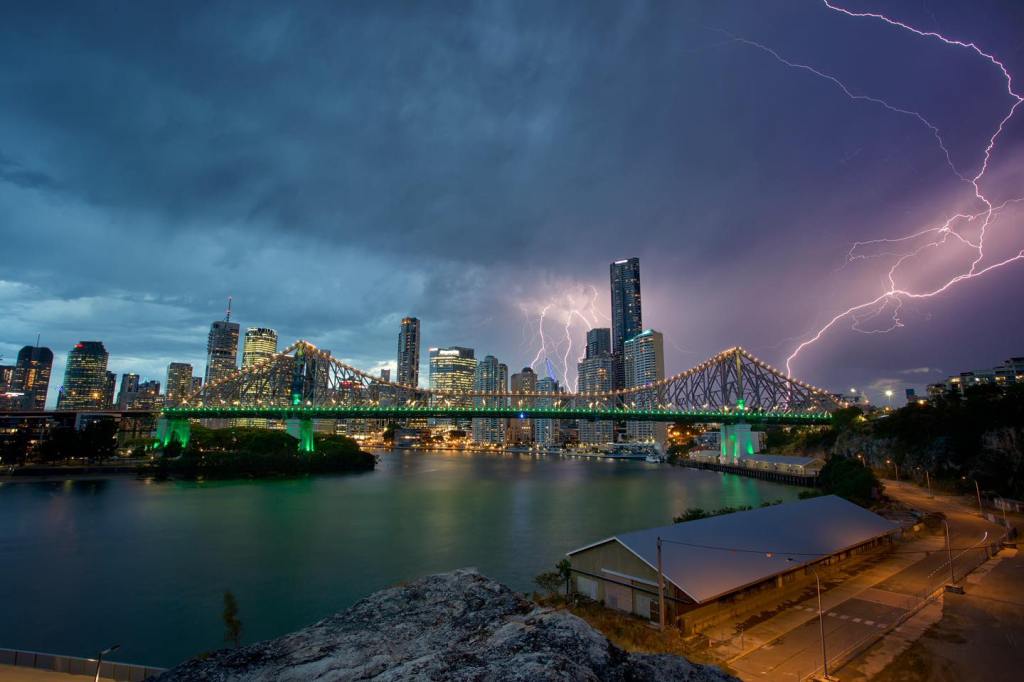
There are between 40 and 60 days in which there are thunderstorms in Brisbane because the combination of tropical air and the nearby Great Dividing Range provide good breeding grounds for these often spectacular celestial events.
Brisbane gets, again on average, between seven and eight hours of bright sunshine a day, more than the southern capitals, thereby justifying its sobriquet as capital of the Sunshine State.
As Mackellar reminded us, drought is always just around the corner. Meteorologist Desmond Gaffney developed an ‘incidence of drought’ that measures how susceptible to drought an area has been. Bearing in mind that we do not have very long records of weather, he calculated that Brisbane had a low to moderate incidence of drought. And of course set against that there have been several notable and damaging floods in Brisbane. All told there have been 39 flood incidents recorded since 1841. Until the severe flood in January 2011, many water engineers believed the city had been insulated from flooding from heavy rains by building upstream dams, especially the one at Wivenhoe. The lesson surely is you cannot control Mother Nature.
Cyclones are also a potential threat, but usually they stay well north of the city and play a greater role in the rest of the state. Queensland’s first official weather man, an eccentric fellow named Clement Wragge appointed in 1887 (inevitably nicknamed ‘Inclement’ by his many critics), began the tradition of naming tropical cyclones. First he used letters from the Greek alphabet, later he used mythological figures and finally the names of politicians of the day, reportedly on the grounds that both were national disasters. Unsurprisingly, this did not make him popular in high places and he was tossed out of his job in 1902.
Averages of course are meaningless because things are hardly ever at that particular statistical point, they are above or below. And the Meteorological Bureau figures quoted in the guidebooks imply a moderation in weather that is not always felt on the ground.
Brisbane writers over the decades have captured the general mood inspired by the weather. ‘The sky was still overcast, and when, between occasional showers, the Sun’s rays broke out, they were excessively hot, and the atmosphere was intolerably close and muggy’, John David wrote in his novel The Dis-Honorouble, published in 1895, before cool summer clothes had been invented and when air conditioners were in the distant future
More recently Peter Carey writes in his novel Bliss of the ‘drippingly humid’ air. Manfred Jurgensen in Break- Out tells of the air being ‘like a wet cloth’. Ross Fitzgerald in Pushed from the Wings reckons the weather made it ‘almost impossible to talk, let alone think or write’. Judith Arthy in Goodbye Goldilocks reports that ‘on steamy afternoons, the rain would pelt down, inches at a time …’
Scientists have tried to establish levels at which weather can cause discomfort, beyond the obvious of getting caught naked in a snow storm. To some extent of course it is a personal matter that varies depending on individual metabolism. But two measures have been developed – effective temperature and the relative strain index.
The first is a combination of temperature, humidity and wind speed because these two latter elements make the body feel hotter or colder than the actual prevailing temperature. It has been found that a normally clothed person sitting down and not doing much physical activity is comfortable when the effective temperature is between 15 and 27 degrees Celsius. There are not consistent records of effective temperatures in Brisbane but the average actual temperature is above that from November to February and the Meteorological Office says there are about 37 days a year when the temperatures reaches over 30C, though in a statistically-imagined average year there are 1.3 days when the temperature is more than 35C. The years of the new Millennium have seen more very hot days than that, as new record high temperatures show.
The two-week long heatwave of February 2004 set new records for temperature highs (41.7C on 22nd of the month) and followed three successive stifling hot Christmases.
New temperature records were set at nine locations in southeast Queensland in early January 2014 as a scorching heatwave hit the region. All-time highs were recorded from the Darling Downs to the Sunshine Coast. Residents in Brisbane’s western suburbs and Ipswich sweltered as the official Bureau of Meteorology gauge at Archerfield soared to 43.5C, just pipping the 43.3C reached in 1940. Logan hit 41.9C, beating the 41C reached a decade earlier.
The relative strain index takes into account these three factors as well as solar radiation, metabolic heart rate and insulation of clothing. On this basis it is reckoned that there are only between five and ten days a year in Brisbane when the critical discomfort level is exceeded. Hogwash, you might say, but remember that they are measuring the discomfort level for someone inside, not exerting themselves too much and where the air is still. Actually, it is probably still hogwash based on the experience of the past few years in Brisbane summers.
The Meteorological Office says there is evidence that the whole country is experiencing an increase in temperature likely to be the result of global warming and that Queensland has been hardest hit with average temperatures up almost one per cent.


Leave a Reply