
The first governor of newly-independent Queensland was that 38 year old Sir George Bowen. He was a highly educated, intellectually minded official not renowned for incisive decision-making who, like many later governors, came from a Protestant Irish Establishment background. He was, by most signs, an earnest but rather dull man.
He arrived in Brisbane from the Ionian island of Corfu in Greece, a well-fortified English staging post for the Crimean War, where he had become accustomed to authoritarian, military rule.
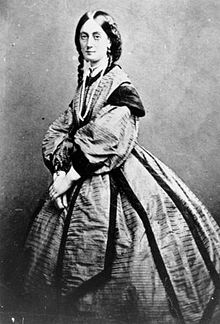
Fortunately, he brought with him his wife, the glamorous Contessa Diamantina Roma, Lady Bowen, a noblewoman from a distinguished family that traced its origins back to 13th Century Rome. She found dusty, dishevelled Brisbane, initially at least, a shock to her sensibilities, though her breeding ensured that she concealed it.
She was born in 1833 on Zakynthos, an island in the Ionian Sea in the Mediterranean between Italy and Greece, the tenth of eleven children and the only surviving daughter of Count Giorgio-Candiano Roma and his wife, the former Contessa Orsola di Balsama. Count Roma was President of the Ionian Senate between 1850 and 1856 and titular head of the Ionian Islands Republic, when the Ionian Islands were a British Protectorate, before they became part of Greece. Queen Victoria also appointed him as the Island’s Poet Laureate. Before her marriage, Diamantina led a gracious, civilised and highly privileged life,
On another Ionian Island, Corfu, the Contessa met and fell in love with Englishman George Bowen, a first class honours classics graduate from Oxford University, and a man with a passion for Greece, its culture and language. He had arrived in Corfu in 1847 as President of the University of the Ionian Islands and in 1854 became Chief Secretary of Government. Two years later in April 1856 Diamantina married Bowen in the chapel of the Palace of St Michael and St George in Corfu. Twelve days later Bowen was knighted.
Following his appointment as the inaugural Governor of the Colony of Queensland, he, Diamantina, and baby daughter Nina sailed to his new domain via Sydney on the sloop HMS Cordelia. During the voyage both Sir George and Lady Bowen suffered repeated bouts of seasickness, but they arrived in Moreton Bay at sunset, Friday 9th December fresh and eager for their challenge. They were met at the mouth of the Brisbane River by a welcoming party in a small Royal Navy paddle-wheel steamer, Breadalbane, whichtook themupstream on a hot, 33 degree Saturday.
All along their journey up the river, they were enthusiastically greeted by paddle steamers filled with sightseers, fireworks, bunting and flags; one local citizen, a Mr Gaskarth, renamed his yacht the Lady Bowen and flew the Greek flag in honour of her homeland. Then four thousand people lined the river banks near the Botanic Gardens and gave them ‘a most wholehearted and joyous welcome’, after which they were taken by vice-regal carriage along dusty streets to the temporary vice-regal residence – Adelaide House, vacated and leased for three years to them by the owner Dr William Hobbs, the Government Health Officer and Surgeon. (It is now The Deanery, St John’s Cathedral). There Diamantina held 16-month-old Nina high over Adelaide Street for the crowd to see. Later that day, from the same veranda, Sir George read the proclamation of the State of Queensland.
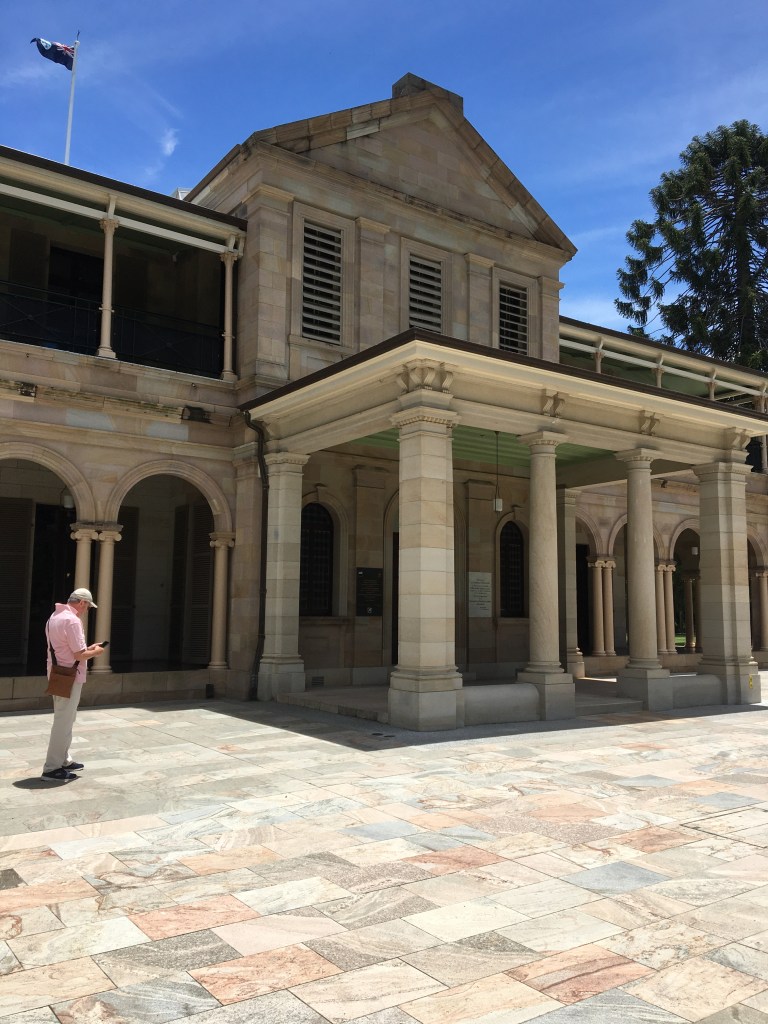
In May 1862 she and her husband became the first occupants of the elegant and spacious new Government House at Gardens Point (now on the campus of the Queensland University of Technology) with its striking arc of, appropriately, Ionian columns. It was built in sandstone and Brisbane porphyry in the Classic Revival Style.
To be in her own house enabled Lady Bowen to entertain in a manner wholly of her own choosing. She was a charming and talented hostess by all accounts. Matthew Henry Marsh, a guest at the first Government House Ball, celebrating the Queen’s birthday on 16th June 1862, reported that ‘Government House is beautiful, and it seems as if the spirit of Greek taste has been given to the colony by Lady Bowen’.
A newspaper report on the ball noted ‘the display was of a description hitherto unapproached in this colony. The three central rooms on the ground floor were given up to the dancers; the large room to the left of the entrance hall was devoted to the purpose of refreshment, where during the evening tea and coffee on one table, and sherry and claret at the other, were dispensed to all comers. The drawing room afforded a grateful refuge for the dowagers as well as those ladies who were disinclined for the dance.
‘The brilliance of the lights, the gay and tasteful costumes of the ladies and the sprinkling of uniforms provided by the Consular Corps, the Army, Navy and Volunteers, presented a spectacle such as had never before been witnessed in the Colony’.
Lady Bowen was an accomplished musician, much admired for her singing and piano playing. She encouraged others by attending concerts and once said ‘of all the arts, music has always been the dearest friend to me’.
Colonial Secretary – in effect the first premier of Queensland – Sir Robert Herbert described Lady Bowen in letters home in glowing terms: ‘her beauty is more in expression than feature’. He commended the pride and love she showed in her children. ‘Lady Bowen often asks me if I have told you about Nina’s [musical] accomplishments’, and on Diamantina’s musical abilities. ‘I like to receive good music, either songs or for the piano, for she is a splendid pianist and plays and sings difficult things at sight’, he reported.
She was also a keen gardener; personally selecting and planting many of the plants in the gardens. The brilliantly hued creeper ‘bignonia venusta’, commonly known as Orange trumpet, covered a cottage near Government House and for a long time was known as ‘Lady Bowen’s Creeper’. It was a striking garden with a vineyard and a variety of fruit trees. From distant Camden in New South Wales botanical enthusiast Sir William MacArthur sent her plants that she acknowledged by letter written in a delicate sloping script.
Lady Bowen frequently left Brisbane alone for unexplained reasons and, often for an extended time. These absences suggested some unhappiness with her husband, discomfort in the Brisbane heat or problems in her ‘emotional health’. Sir George did subsequently publicly describe her absence for a year from Victoria [where he was later to be Governor] as ‘a short visit to Europe necessitated by her state of health’.
Herbert said ‘Lady Bowen still looks young and pretty, but is not very strong. The summer heat and her husband’s eccentricities are trying to her health’.
Three of the Bowen’s children were born in Brisbane. Her third child, born two years after arrival and christened Agnes Herbert suggests that Diamantina reciprocated Herbert’s probably platonic affection. He was a confirmed bachelor, and shared his house in Herston with John Bramston, the state’s Attorney General.
The Bowens had spent eight years in Queensland during which Brisbane had grown from 4,000 to a lusty embryonic city of 15,000.
Before her departure from Queensland, 120 women subscribed to give her a diamond necklace as a memento of ‘the admiration and regard which the English ladies of this colony feel for the “Lady of the Greek Isles” who has so gracefully presided over them.’
In a farewell address they declared ‘Eight years ago you came among us as a stranger and foreigner. You leave us having won the hearts of many and the goodwill of all. The poor, the destitute, the afflicted and the orphans have alike shared your sympathy’.
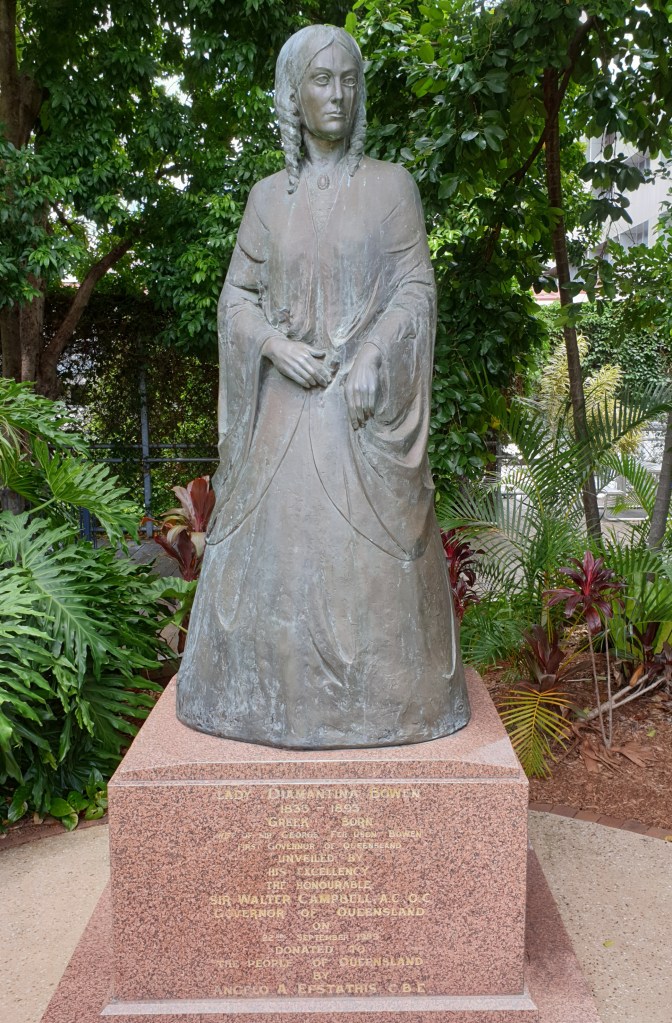
At the time she was 34 years old, but most observers thought she looked younger; confirming contemporary gossip that she always had her hair in ringlets to achieve such a look. The only surviving painting of her in Queensland is at All Hallows School. A life size bronze statue by Philip Piperides donated by Angelo Efstathis originally erected outside the Greek Club in Brisbane’s West End, now stands on the southern lawn of the old Government House.
Contemporary reports show she was greatly admired in Victoria too. One newspaper rhapsodised: ‘A Creature as exotic as a bird of paradise, still a beauty, with black dazzling eyes, a flawless cream complexion and a figure that, even in the dresses of the period, was the envy of many younger matrons in the Government House circle’.
Mrs Campbell Praed, reminiscing about Lady Bowen’s time in Brisbane in her book My Australian Girlhood, published in 1902, concluded that ‘Never had we ever seen anyone faintly resembling this gracious being, with her kindly smile, a soft foreign accent, about whom everything from the bow of ribbon in her hair to the filmy pocket handkerchief with its monogram seemed to exhale an odour of romance. Strange indeed must have been the crudities of Australian life to this gifted Greek lady whose brilliant accomplishments and delicate charm might have seemed somewhat out of place in this primitive colony just given a name and an existence of its own’.
On departure in January 1868 from Brisbane the Bowens walked from Government House through the Botanical Gardens cheered by thousands to board the government steamer Platypus. Reports say that Lady Bowen was overwhelmed with emotion at parting from her home and friends of eight years. Apparently she never raised her head through the Gardens and was sobbing bitterly and scarcely able to walk. On reaching the jetty she broke down and needed to be carried to her cabin on the Platypus.
The next day’s newspaper noted, in keeping with the spirit of that more deferential age: ‘Ever since she has been in the colony she has identified herself in the most hearty and zealous manner with every good and charitable work which has been set on foot, and not a few have been originated and warmly promoted by her efforts.’
Unfortunately what Lady Bowen herself thought of Brisbane and Queensland will never now be known. Hundreds of her letters to family and friends are lost. They were preserved for 80 years in the Roma family villa, but were destroyed in the earthquakes in Ionian Islands in 1953.
Sir George went on to hold the post of governor in New Zealand, Victoria, Mauritius and Hong Kong. The Bowen’s daughter Agnes regarded her mother as the perfect wife of a Governor, and believed that without her as a hostess and helpmate Bowen’s career would have been insignificant. She died in London 1893, aged sixty, after she developed acute bronchitis.


Leave a Reply